

Les femmes et l'intelligence artificielle (IA)
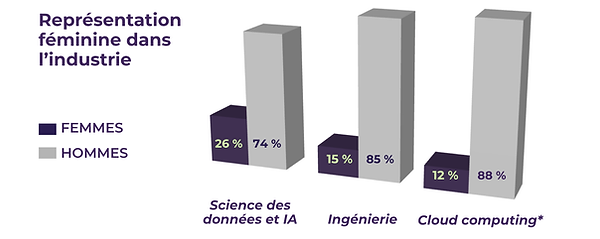
L'intelligence artificielle représente l'une des avancées technologiques les plus marquantes de notre époque. Pourtant, l’IA demeure l’un des secteurs technologiques où les femmes sont les moins représentées.
Grâce au soutien d'IVADO, Parité sciences met à la disposition de la communauté éducative des ressources fondées sur la recherche pour aborder les enjeux liés à l'IA, développer l'esprit critique des jeunes et favoriser une plus grande représentation des filles et des femmes dans les domaines qui contribuent à son développement.


TEACHING TOOLS
Infographics
These infographics were created by the Parité sciences team to raise awareness, inform and inspire all those who wish to contribute to a more inclusive future in science.
Content
Discover highlights exposing the issues related to the under-representation of women in science in Quebec.
Objective
At a glance, you will be able to:
-
Exploring key data that illustrates gender gaps in STEM
-
Understanding the specific challenges faced by women wishing to pursue careers in STEM.
-
Discover key statistics on the evolution of parity and the progress made in Quebec.
-
Identify levers for action to support and encourage the participation of women in these areas of the future.
Format and usage
PDF ready to email or print
Des ressources gratuites pour amorcer la réflexion
Infographie téléchargeable
Découvrez les principaux enjeux liés aux femmes et à l’intelligence artificielle grâce à cette infographie claire et accessible.
Un outil idéal pour amorcer la réflexion avec vos collègues ou vos étudiant·e·s sur les biais algorithmiques, la diversité et la place des femmes dans les carrières en IA.
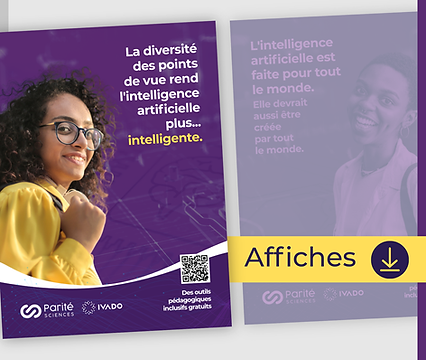
Affiches à télécharger ou à commander
Sensibilisez votre communauté éducative aux enjeux liés à la représentation des femmes en IA grâce à cette série de trois affiches. Un code QR dirige vers les ressources de Parité sciences.
Téléchargez-les pour les imprimer ou commandez gratuitement des exemplaires en grand format, livrés directement à votre établissement.
These infographics were created by the Parité sciences team to raise awareness, inform and inspire all those who wish to contribute to a more inclusive future in science.
Content
Discover highlights exposing the issues related to the under-representation of women in science in Quebec.
Objective
At a glance, you will be able to:
-
Exploring key data that illustrates gender gaps in STEM
-
Understanding the specific challenges faced by women wishing to pursue careers in STEM.
-
Discover key statistics on the evolution of parity and the progress made in Quebec.
-
Identify levers for action to support and encourage the participation of women in these areas of the future.
Format and usage
PDF ready to email or print
D'où viennent les biais?
Les biais algorithmiques peuvent avoir plusieurs origines.
Trois facteurs jouent un rôle particulièrement important :
1. Les valeurs et les inégalités présentes dans la société
Les systèmes d'IA apprennent à partir de contenus produits par des êtres humains. Les données utilisées reflètent donc les réalités, les normes sociales, les stéréotypes et les inégalités qui existent déjà dans la société.
2. Les choix effectuées lors de la conception des systèmes d'IA
Le développement d'un système d'IA implique une multitude de choix humains :
-
les données sélectionnées;
-
les variables retenues;
-
les objectifs poursuivis;
-
les critères utilisés pour évaluer les résultats.
Ces décisions influencent directement le fonctionnement des systèmes.
3. Les données d'entraînement
On dit souvent que l'IA est, fondamentalement, une question de données.
Si certains groupes sont sous-représentés, mal représentés ou représentés de façon stéréotypée dans les ensembles de données, ces déséquilibres risquent d'être reproduits par les systèmes d'IA.
These infographics were created by the Parité sciences team to raise awareness, inform and inspire all those who wish to contribute to a more inclusive future in science.
Content
Discover highlights exposing the issues related to the under-representation of women in science in Quebec.
Objective
At a glance, you will be able to:
-
Exploring key data that illustrates gender gaps in STEM
-
Understanding the specific challenges faced by women wishing to pursue careers in STEM.
-
Discover key statistics on the evolution of parity and the progress made in Quebec.
-
Identify levers for action to support and encourage the participation of women in these areas of the future.
Format and usage
PDF ready to email or print
These infographics were created by the Parité sciences team to raise awareness, inform and inspire all those who wish to contribute to a more inclusive future in science.
Content
Discover highlights exposing the issues related to the under-representation of women in science in Quebec.
Objective
At a glance, you will be able to:
-
Exploring key data that illustrates gender gaps in STEM
-
Understanding the specific challenges faced by women wishing to pursue careers in STEM.
-
Discover key statistics on the evolution of parity and the progress made in Quebec.
-
Identify levers for action to support and encourage the participation of women in these areas of the future.
Format and usage
PDF ready to email or print
These infographics were created by the Parité sciences team to raise awareness, inform and inspire all those who wish to contribute to a more inclusive future in science.
Content
Discover highlights exposing the issues related to the under-representation of women in science in Quebec.
Objective
At a glance, you will be able to:
-
Exploring key data that illustrates gender gaps in STEM
-
Understanding the specific challenges faced by women wishing to pursue careers in STEM.
-
Discover key statistics on the evolution of parity and the progress made in Quebec.
-
Identify levers for action to support and encourage the participation of women in these areas of the future.
Format and usage
PDF ready to email or print
.png)
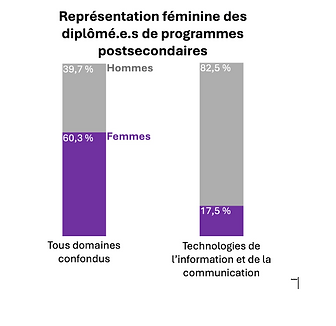
Une sous-représentation qui apparaît dès les études
Au Québec, les femmes ont obtenu 60,3 % de l'ensemble des diplômes postsecondaires entre 2021 et 2024. Si les choix d'études étaient répartis de façon similaire dans tous les domaines, il est plausible de s'attendreà retrouver une proportion comparable dans les programmes liés aux technologies de l'information et de la communication. Or, elles n'y représentent que 17,5 % des diplômé·es.
Cet écart illustre que les femmes demeurent sous-représentées dans certains domaines qui constituent des voies d'accès importantes vers les carrières en IA.
Téléchargez l'infographie
Vers une intelligence artificielle plus équitable et découvrez comment vous pouvez faire partie du changement.
Articles recents


